The Reading Layer
Jaydev Gusani
A reading mode for modern AI interfaces.
Chrome
Firefox
THE INHERITED EQUATION
Every major AI interface is built from two borrowed defaults.
The first is messaging UI.
Inherited from SMS, iMessage, WhatsApp.
Built for short, disposable
conversational exchange.
Chat bubbles. Turn-based layout.
Interaction-first hierarchy.
Built
for speed Not retention.
The second is the markdown renderer.
Inherited from blogging and lightweight publishing systems.
Built for portable text.
Constrained columns.
Minimal hierarchy Document-lite aesthetics.
Built for portability.
Not comprehension.
Neither system was designed
for long-form machine output.
Someone combined both.
Messaging
UI plus Markdown Renderer became the default AI interface.
The result:
A narrow vertical stream.
600 to 800 pixel containers.
Dead space on both sides
of the screen.
Flat hierarchy.
No retrieval layer.
No reading mode.
The structure was
not designed.
It was assembled from inherited defaults and left unexamined.
This is The Inherited
Equation.
Intelligence expanded
The equation did not
The Cost
This is not a capability problem.
It is a cognitive friction problem.
When intelligence exceeds
its container, the user absorbs the cost.
You experience it as fatigue.
Excessive scrolling.
Fragmented attention.
Code and prose
compressed into the same conversational stream.
Everything flattened into sequential flow.
Nothing persists visually.
Nothing anchors memory.
You are not reading.
You are continuously relocating context.
The system forgets nothing.
The user cannot find it.
As models improve, the interface degrades proportionally.
Longer outputs inside unchanged containers
produce navigational exhaustion.
The model scales Comprehension does not.
THE MISTAKE
Chat and reading are not the same activity.
They resemble each other superficially.
Structurally
they are opposites.
Chat is reactive.
Fast.
Disposable.
Interrupt-driven.
Reading is cumulative.
Slow.
Spatial.
Hierarchical.
One optimizes exchange.
The other optimizes understanding.
We built interfaces for the first.
We
are now forcing them to perform the second.
That is the mistake.
The Pattern
The pattern repeats across every major platform.
Not metaphorically.
Literally.
OpenAI / ChatGPT
--thread-content-max-width: 48rem
Anthropic / Claude
.max-w-3xl { max-width: 48rem; }
Google / Gemini
.conversation-container { max-width: 760px; }
Perplexity
--thread-content-width: 720px;
xAI / Grok
--content-max-width: 48rem;
Microsoft / Copilot
.max-w-chat { max-width:min(100%,48rem) }
Alibaba Cloud / Qwen
.qwen-chat-message { max-width: 800px; }
DeepSeek
--message-list-max-width: 840px;
Moonshot AI / Kimi
max-width:800px
Sarvam AI
.max-w-3xl { max-width:48rem }
Different companies.
Different models. Different infrastructures.
The same inherited container.
The naming reveals the assumption beneath the system:
thread, conversation, chat, message
not:
document, reading, knowledge, memory
The interface vocabulary never evolved beyond messaging metaphors.
The systems became larger.
The
container did not.
This list is actively maintained.
File names may rotate on platform deploys CSS variable values are
the stable reference.
Last revised date displayed opposite the title.
The Reading Layer
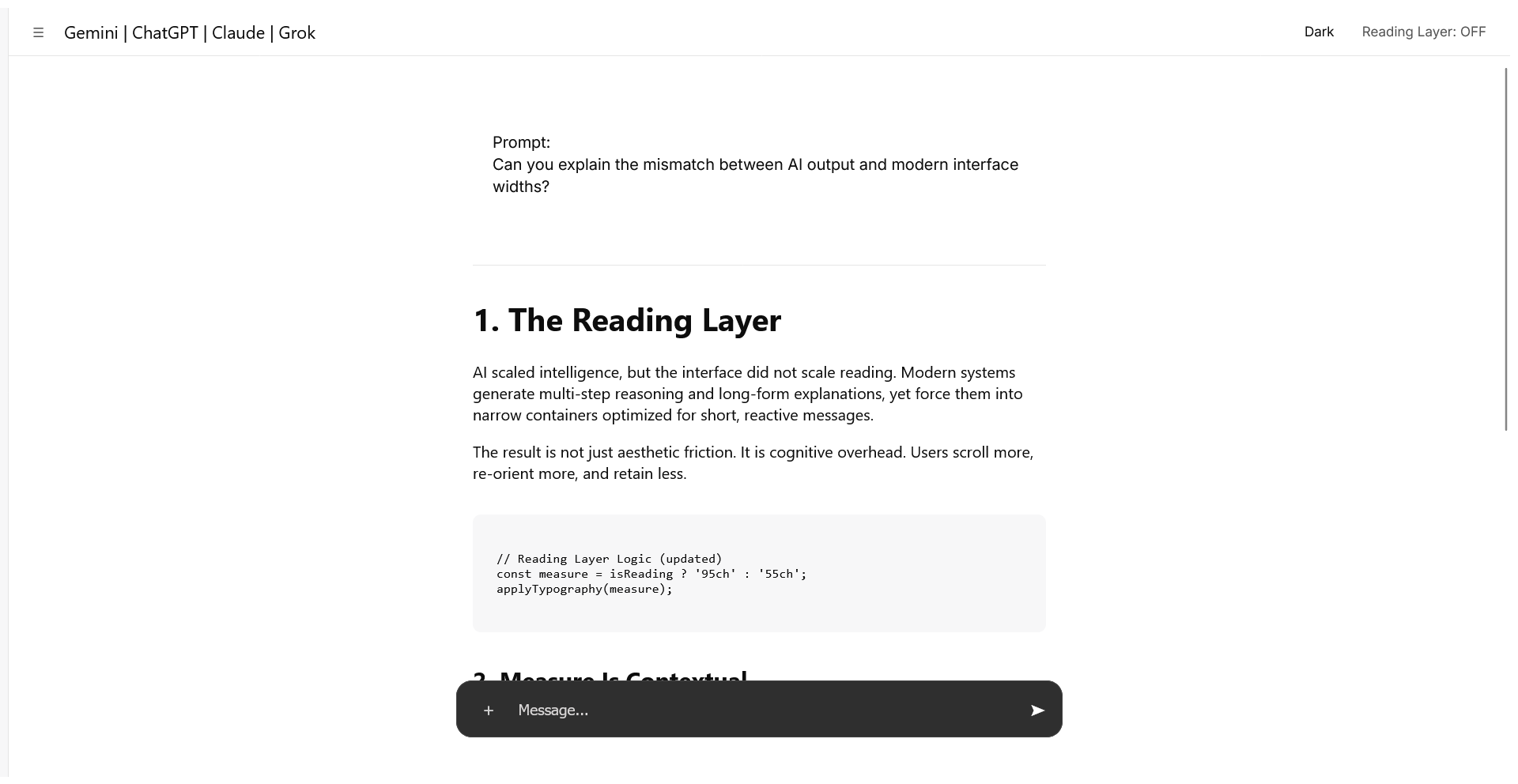
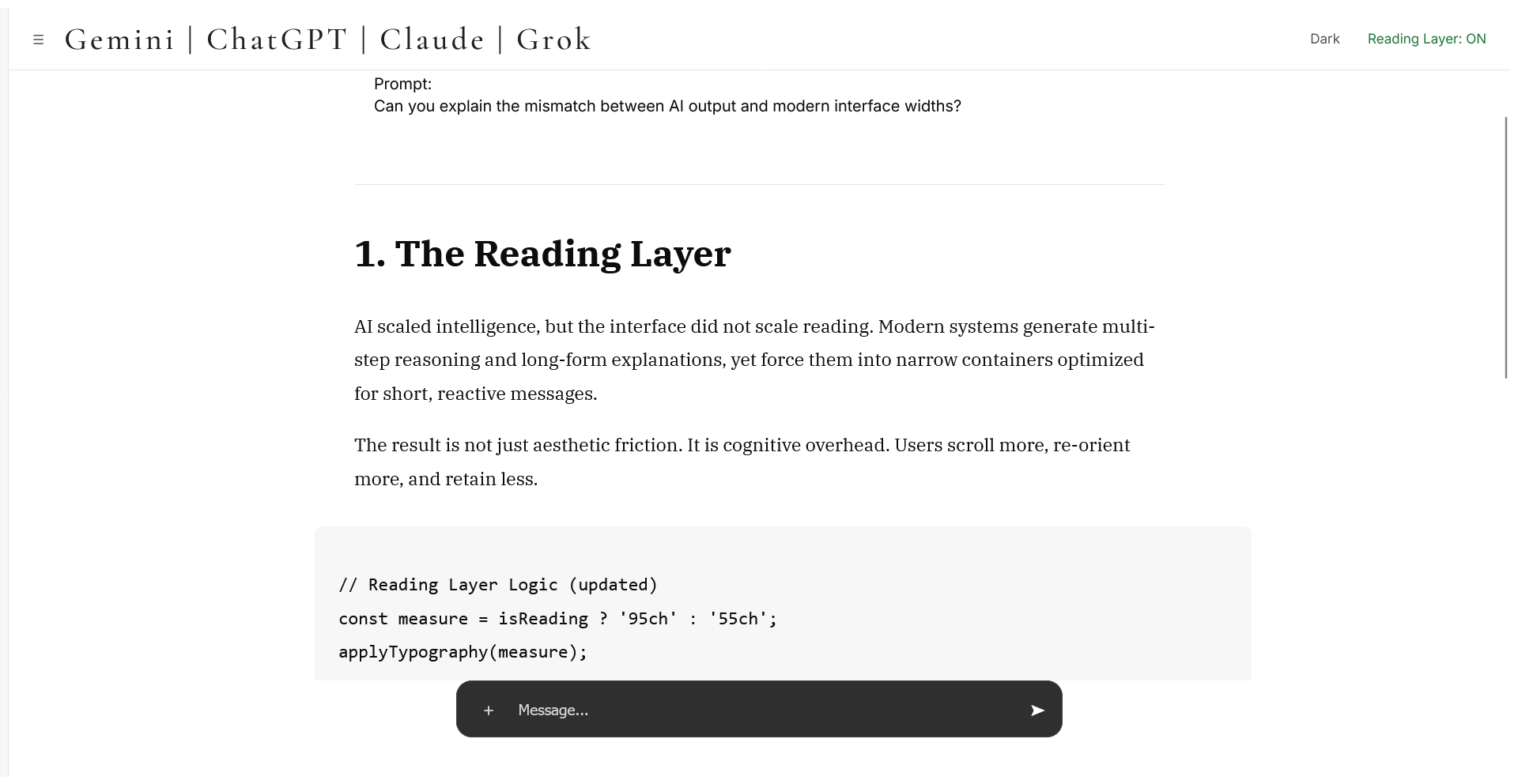
The interface should not remain static.
It should classify intent before reading begins.
The system already knows the difference between:
a quick exchange
and
a document requiring
attenion.
The trigger is not output length.
It is cognitive mode.
multiple headers.
extended code
blocks.
Research-oriented prompts.
Requests beginning with:
explain
analyze
summarize
compare
design
The interface
should commit structurally before the first token appears.
Not visually
Structurally
the layout expands, typography shifts, hierarchy becomes visible.
Code escapes containment
spacing slows the eye.
The response stops behaving like a message.
It becomes readable.
A reading layer is not decoration.
it is cognitive infrastructure.
The
system was researched, written, designed, implemented, and maintained within the same boundary of
authorship.
The Implementation
This does not requre a new model.
It does not require a new pipeline.
It is a conditional interface state.
One decision applied early.
The system detects intent.
The container adapts.
Then it disappears into normality because it is functioning correctly.
The cost is trivial
the absence is not
The Experiment
The industry already proved the limitation accidentally.
Models scaled beyond conversational density.
Interfaces remained conversational anyway.
ChatGPT scaled reasoning
The interface remained a scrolling message stream.
Claude scaled restraint.
The interface almost evolved.
it understands something subtle:
interaction and reading are not the same.
it almost commits to a reading-first system then pulls back
Gemini scaled context windows
while preserving centered conversational rendering.
Perplexity scaled retrieval while preserving thread-based interaction.
Search became conversational.
Research remained trapped inside message flow.
Grok scaled infrastructure through Project Colossus.
Massive distributed compute. Continuous real-time
systems.
The interface remained reactive.
The output remained trapped inside inherited
conversation structures.
Copilot inherited the productivity ecosystem.
Documents, Operating systems, Enterprise workflows.
The interface still converged toward conversational containment.
Qwen expanded multilingual capability while preserving inherited messaging architecture.
DeepSeek optimized reasoning efficiency while preserving the same narrow vertical stream.
Different models.
Different infrastructures.
Different research priorities.
The same
inherited container repeated across every system.
The model changed.
The container survived.
The excuse
This is not a technical limitation.
The constraint is trivial to modify.
The pattern persists because inherited defaults became invisible.
 48rem
 768px
 800px
repeated across platforms.
Repeated across companies.
Repeated across valuation scales.
The same number inherited repeatedly becomes perceived inevitability.
that is not caution
that is stagnation
The Position
We scaled intelligence.
We did not scale comprehension
The bottleneck is no longer generation.
It is interface.
A reading layer is not a feature.
It is missing infrastructure.
The gap between machine output and human understanding is no longer computational.
It is
architectural.
Generation became abundant.
Comprehension remained scarce.
THE EXTENSION
Reading alone does not complete the system.
Display solves comprehension temporarily.
Retrieval
solves continuity.
A reading layer handles presentation.
A memory layer handles return.
Both belong to the same
unfinished architecture.
The Prompt Journal extends this
argument into retrieval.
The interface should not only generate knowledge.
It should preserve
orientation inside it.