HTML Foundry Case Study
Jaydev Gusani
Overview
HTML Foundry is a client-side tool for compiling Markdown into structured, deployment-ready HTML.
The system compiles Markdown, CSS, SEO metadata, and JSON-LD into a single, complete document that can be shipped with minimal or no post-processing.
All processing occurs client-side and is deployed at the edge
System Context & Problem
Most existing publishing tools are built around convenience and abstraction, but introduce unnecessary
complexity for simple, structured publishing workflows.
In practice, this meant manual cleanup of HTML,
fragmented SEO metadata, and inconsistent output structures.
The goal was to build a tool that produces predictable, structured HTML with embedded metadata, without
runtime dependencies or backend infrastructure.
The output is designed to be complete, portable, and
ready to deploy as-is.
Architecture & Performance
The system is built on a "No Backend" philosophy, running entirely client-side to remove hosting requirements and operational overhead. All transformations happen at compile-time, ensuring the generated output contains zero runtime dependencies and no framework lock-in.
By including SEO metadata and JSON-LD during the generation process, the architecture ensures documents are machine-readable and indexing is consistent without manual intervention.
Interface Design
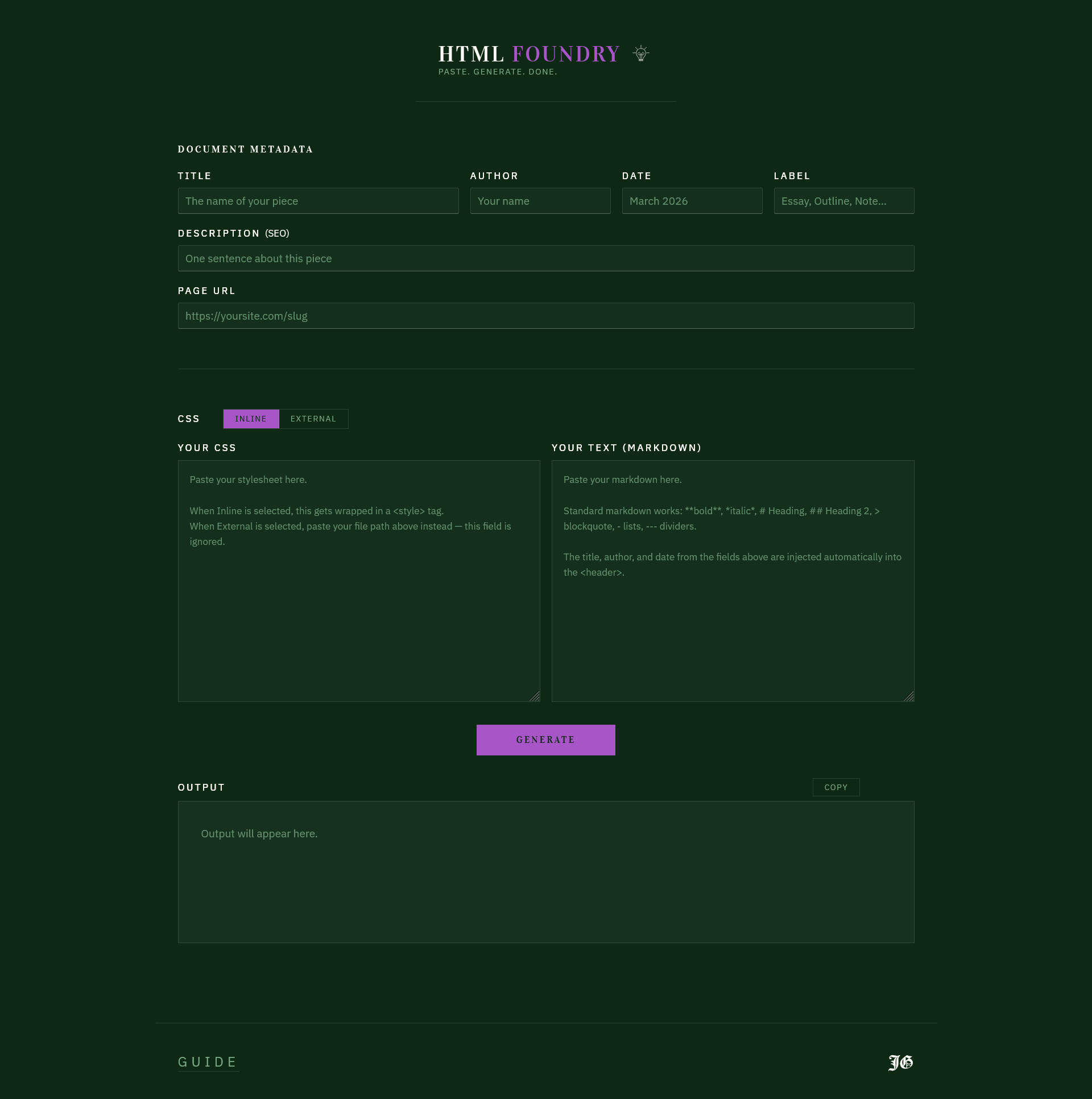
The interface is intentionally minimal and constrained, following a strict flow of input → generate → output. It avoids scope creep by excluding common features like accounts, storage, or live previews.
This deliberate constraint preserves speed and clarity, focusing on a single-purpose workflow:
paste → generate → copy → deploy.
It assumes the user values a focused, repeatable
task over a feature-rich UI.
Outcome
HTML Foundry reduces the effort required to produce structured documents, enabling faster publishing
workflows and eliminating repetitive manual steps.
It is tailored for developers and technical writers
who prefer static, durable systems over traditional CMS platforms.
Even partial use provides value by shifting the focus from feature accumulation toward intentional, durable systems that prioritize long-term reliability.
Future Updates
Building this tool reinforced that many modern tools are overbuilt for simple tasks.
Future iterations
will focus on refining the internal compiler to handle even more complex semantic structures while
maintaining the zero-dependency footprint.
We aim to continue improving performance and reducing maintenance overhead, ensuring HTML Foundry remains the fastest path from raw Markdown to a professional, independent web document.
Tradeoffs
The system prioritizes deterministic output and zero runtime over flexibility.
Markdown parsing is handled via a CDN-hosted dependency.
This reduces setup complexity and enables
immediate use, but introduces reliance on an external source for a critical transformation step.
The pipeline avoids dynamic behavior and client-side state.
This ensures fast, predictable output, but
limits support for interactive features and more complex content workflows.
The interface is intentionally constrained to a single-pass flow.
While this preserves clarity and
speed, it restricts extensibility for custom components or non-linear authoring patterns.
End-to-End Development
HTML Foundry was developed in response to a gap in existing publishing workflows, where structure, metadata, and output were fragmented across multiple tools.
The system was designed and implemented as a single, constrained pipeline.
The interface, compilation
logic, and output structure were built together to enforce a clear flow: input → generate → deploy.
The guide is part of the system.
It defines the boundaries of use, clarifying what the tool does and
explicitly what it does not do.
The platform is deployed on an edge network, ensuring immediate access without introducing hosting or runtime dependencies.